
Newnan City Directory Holdings
The Coweta County Genealogical Society, or CCGS, holds the verified bound Newnan city directory run. Publication is intermittent, so the specific years matter more than a broad date range. The publisher is not stated in the catalog and must not be guessed.
| Collection | Years | Where Held | Access |
|---|---|---|---|
| Bound Newnan city directories | 1949, 1959, intermittent 1961-1998 | CCGS, shelves F-18TOP/F-18A | In-person research |
| Newnan telephone directories | 1996-2007 | CCGS | Physical holdings |
| Map, History and Directory of Coweta County | About 1921 | Georgia Archives Virtual Vault | Free digitized item |
| Census transcriptions and indexes | 1840-1920 selected decades | CCGS | In-person research |
The verified bound years are 1949, 1959, 1961, 1962, 1964, 1966, 1967, 1969, 1971, 1973 through 1976, 1978 through 1983, 1986, 1988, 1990 through 1992, and 1994 through 1998. The missing years are research gaps, not evidence that a resident moved or a publisher stopped.
Telephone books extend the listed-name trail through 2007, though a phone listing is not the same record as a bound city directory entry. For earlier work, the 1921 Herald item, census volumes, marriage material, and tax sources provide different kinds of dated evidence. Keep a source log that names the collection, year, page or image, and repository. That makes conflicts visible instead of blending them into one unsupported address history.
Read Newnan Directories at CCGS
The Coweta County Genealogical Society library is at 8 Carmichael Street. It is open Wednesday through Friday from 10 to 4 and Saturday by appointment. Beyond city directories, its shelves include surname books, family folders, newspapers, military works, magazines, pamphlets, census material, cemetery books, and probate indexes. Those companion sources help resolve initials and same-name people.
The society's public collection page is shown below. Contact the library before a visit when one exact Newnan city directory year is essential, since catalog evidence does not prove that every volume is always available for use.
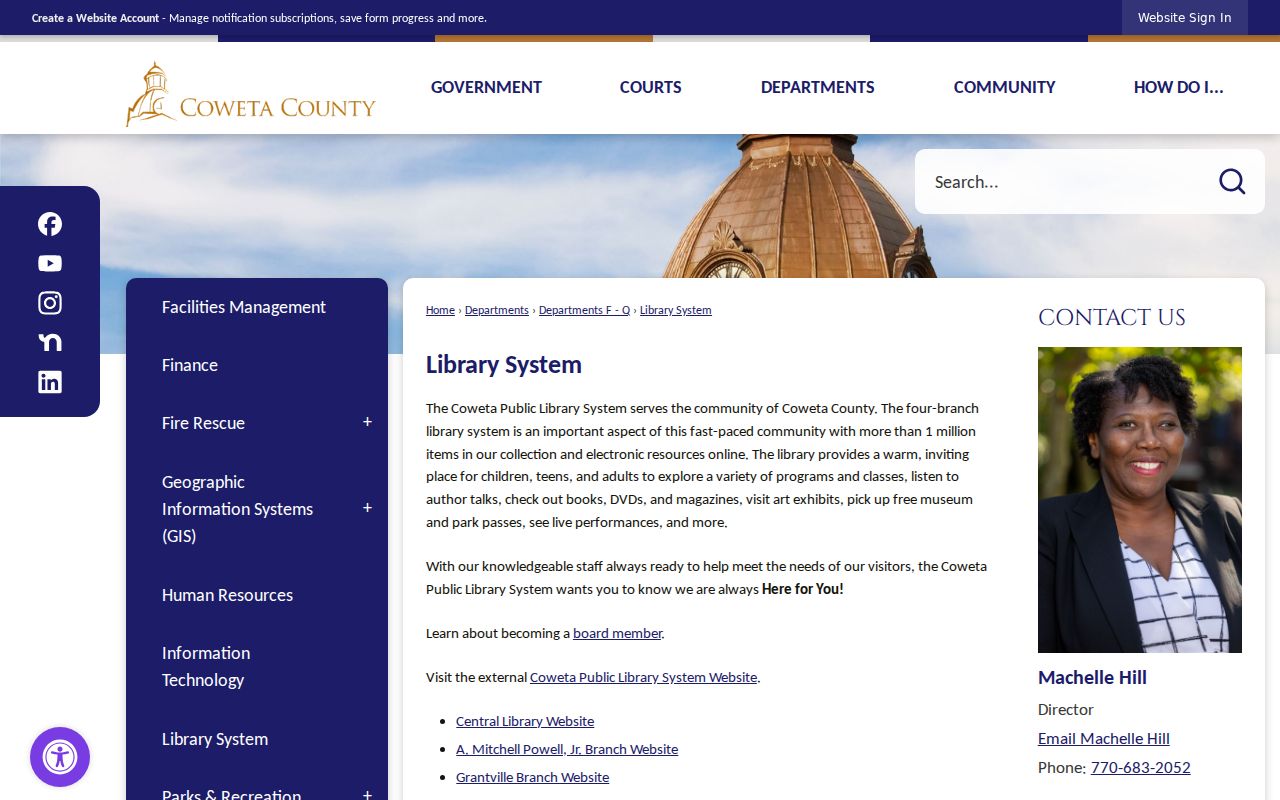
The official Coweta library system lists four branches and local contacts, while CCGS owns the specialized directory inventory used here. Georgia Archives in Morrow supplies another fallback with its Virtual Vault, county microfilm catalog, and onsite genealogy databases. NARA Atlanta is relevant for federal census and naturalization material. Before 1906, however, any court of record could naturalize, so some local proceedings may remain outside federal custody.
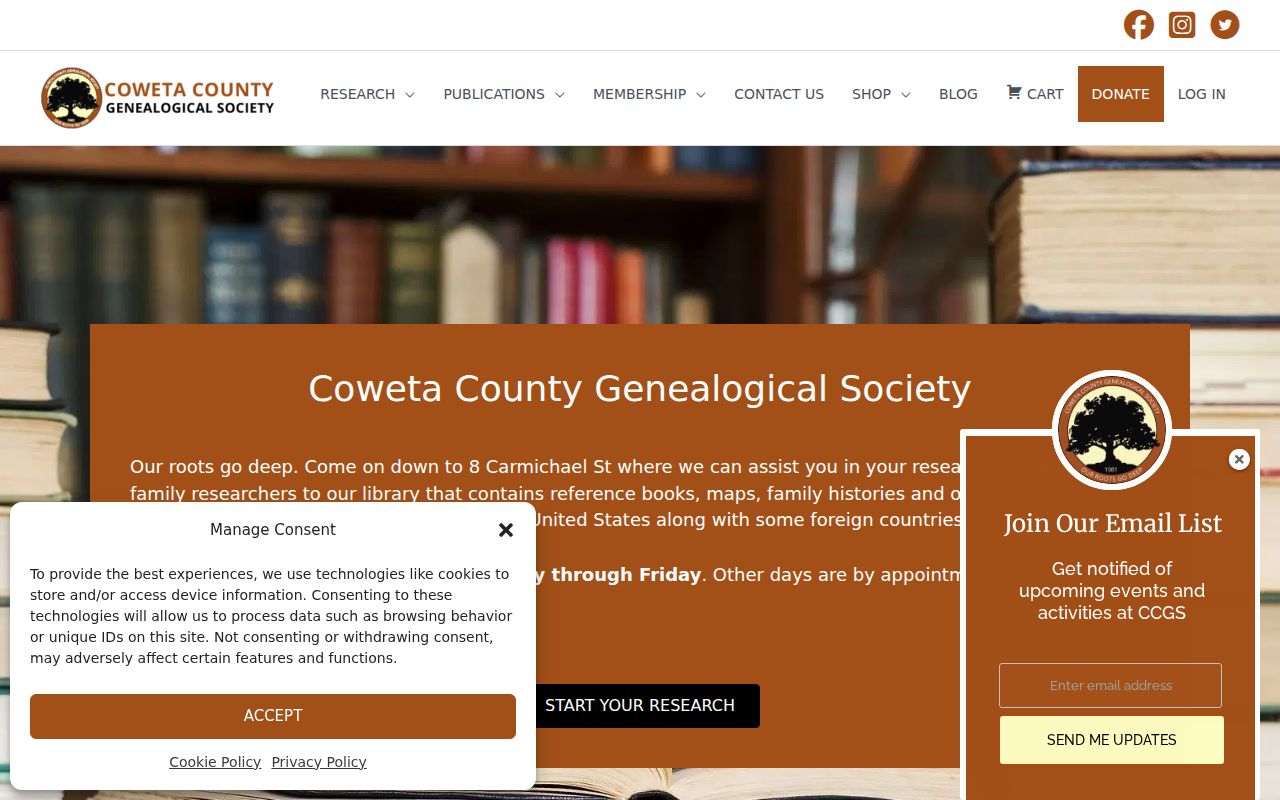
The separate Coweta library overview identifies the county's four public branches and their contact routes.
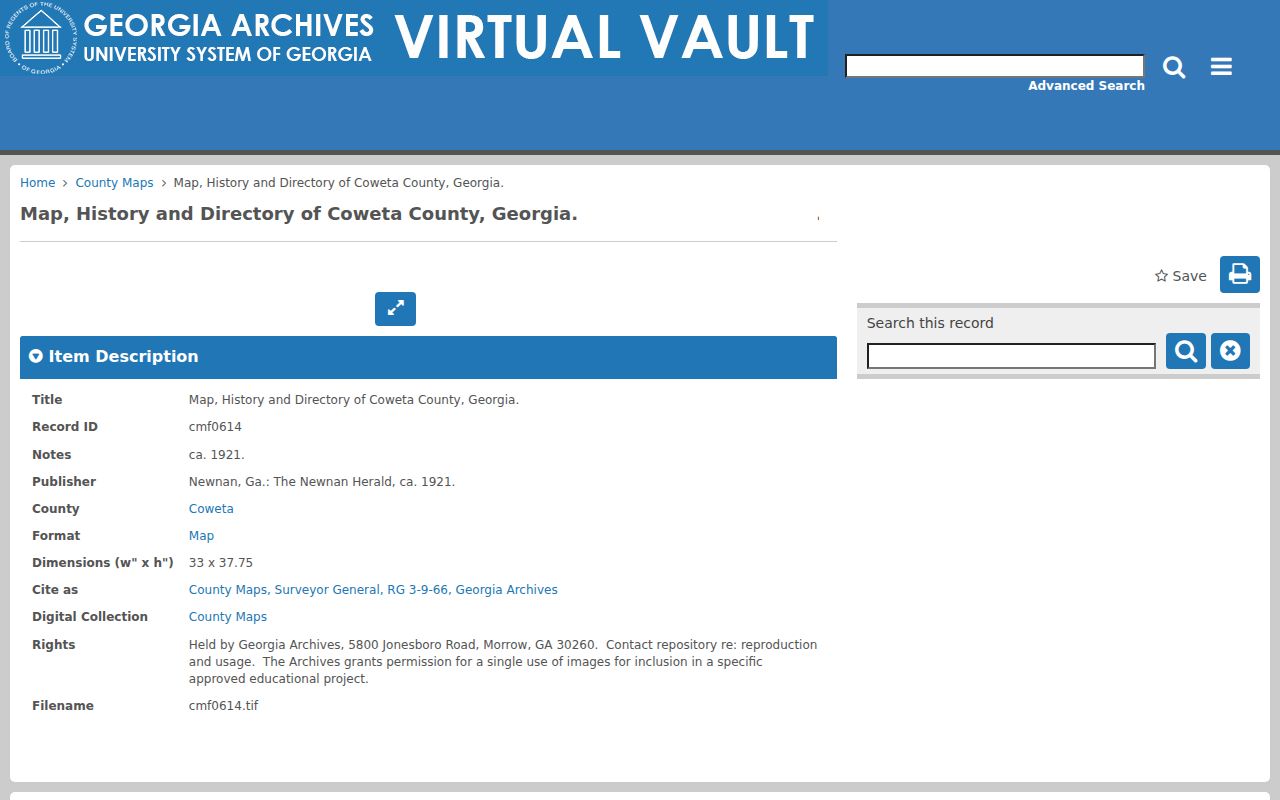
The 1921 Newnan Directory Map
The Newnan Herald Map, History and Directory of Coweta County is a digitized hybrid from about 1921. It is not the same thing as the later bound city-directory run. Browse the image itself before transcribing a person, then cite the item and image where the text appears.
The Georgia Archives record is reproduced below as a source interface. It gives remote researchers a direct route to the early directory artifact without claiming a full text search.
Begin with the item's own browse controls and image sequence. A map label, historical paragraph, and directory entry serve different purposes even when bound together. Transcribe the exact text, preserve its page context, and compare the resulting name or place with a separate county record. The hybrid format is useful precisely because it joins local geography and names, but that does not make every statement current or complete.
Decode a Newnan Directory Entry
Georgia city directories generally arrange residents alphabetically and may include an address, occupation, spouse, and other household facts. The actual Newnan entry layout has not been verified from a digitized bound volume. Inspect the title page and key in each volume, because two publishers can use different marks in the same era.
| Name | Copy surname, given name, middle initial, and any spouse exactly as printed. |
|---|---|
| Work line | Record occupation and employer only when the entry supplies them. |
| Address | Preserve house number, road wording, and any residence mark. |
| Household mark | Use owner, householder, or boarding marks only as that volume defines them. |
| Widow notation | Copy the wording and associated spouse name without expanding an unknown abbreviation. |
- Criss-cross directory
- A section arranged by street and house number, if the volume includes one.
- Householder index
- An address-oriented list of the person identified as householder by that publisher.
- Abbreviation key
- The volume's own legend for shortened terms and symbols. Copy it before interpreting entries.
Do not invent local abbreviations from a generic directory example. Photograph or transcribe the key with the entry. That small step prevents a letter meant for residence, rooming, or another publisher-specific term from becoming a false fact.
Pair 1949 Newnan with 1950
The 1949 city directory and the public 1950 federal census form Newnan's cleanest mid-century cross-check. Start with the directory name and address. Then inspect the census household for names, relationships, ages, and other fields recorded by the enumerator. Agreement supports the match; disagreement calls for more evidence.
As of 2026, 1950 is the latest public federal census under the 72-year release rule. City directories can bridge the ten-year census gaps, but Newnan's held years remain irregular. The jump from 1949 to 1959 is a full decade, so never interpolate an address across it.
Newnan's 1890 Tax Bridge
The Coweta collection includes an 1890 tax digest that can partly bridge the destroyed federal census schedule. A tax digest records taxable people and property, not the full population. Use it to place a named taxpayer or asset, then compare probate, deed, newspaper, church, and cemetery sources.
CCGS also holds selected census transcriptions or indexes for 1840, 1850, 1860, 1870, 1880, 1900, 1910, and 1920. The 1890 digest is valuable because of the national gap, but its narrower purpose must remain visible in every conclusion.
Newnan Church Directory Networks
Church and member directories add dated social ties that a standard Newnan city directory may omit. CCGS lists Macedonia Baptist material from 1900, 1994, and 1998; Mills Chapel from 1958; Central Baptist from 1986; First Baptist items from 1983, 1986, and a 1991 resident membership list; plus later Grantville, Turin, and Andrews Chapel volumes.
These sources document membership at the time of publication. They do not prove a lifelong affiliation or residence. Compare a church entry with an address-bearing source and cite the congregation, year, and page.
Newnan Newspapers Fill Directory Gaps
By 1987, the Newnan-Coweta Historical Society had microfilmed a century of local newspapers. CCGS holds extracts from the Herald Advertiser for 1887 and 1888, Newnan Weekly for 1906 and 1907, Times-Herald birth and marriage abstracts, and bound 1992 through 1994 issues. Newspaper notices can explain a move, death, marriage, or change in business name between directory years.
The Newnan-Coweta History Center adds photographs, oral histories, exhibits, and an archive at 74 Jackson Street. Its collections page appears below. Item-level evidence should retain the image or item identifier.

Map Newnan Directory Addresses
The Library of Congress has six Newnan Sanborn map editions: 1885, 1889, 1895, 1900, 1906, and 1911. They show street names and numbers, footprints, construction materials, uses, and outbuildings. Sanborn maps do not name occupants.
Use a map after a city directory, deed, tax, or census source has identified the person. The map can then test whether the street number or structure continued. For modern address-based ownership, shift to the Newnan street directory workflow rather than treating an old map as current evidence.
Trace Family Through Newnan Directories
A family trail should preserve every date and role. A city-directory appearance shows only what that volume printed. Census, probate, cemetery, marriage, and newspaper records can test the identity and explain why a name later disappears.
- Find the earliest held volume containing the full name or a supported variant. Copy the entry and its key.
- Move to the nearest prior and next held years. Note every address and name-form change without filling missing years.
- Check the address section only if that Newnan volume includes one. Compare others listed at the same property.
- Pair the 1949 directory with the 1950 census, and use the nearest census for earlier periods.
- Close a disappearance with newspaper, obituary, probate, marriage, cemetery, or deed evidence.
A person can vanish because of death, a move, nonpublication, omission, a surname change, or a missing volume. Only a second dated source can distinguish those possibilities. For African-American family research, Georgia Archives materials such as the 1867 Reconstruction voter returns and apprenticeship or indenture registers can extend the trail beyond the later city-directory era.